What is Treasure Hunts
Learn how Treasure Hunts combine venue-based discovery, 3D or AR objects, and progression across a physical space.
In this article, you'll learn what Treasure Hunts are, how the hunt and object layers work together, and when this app is the right fit for your campaign.
What Treasure Hunts are
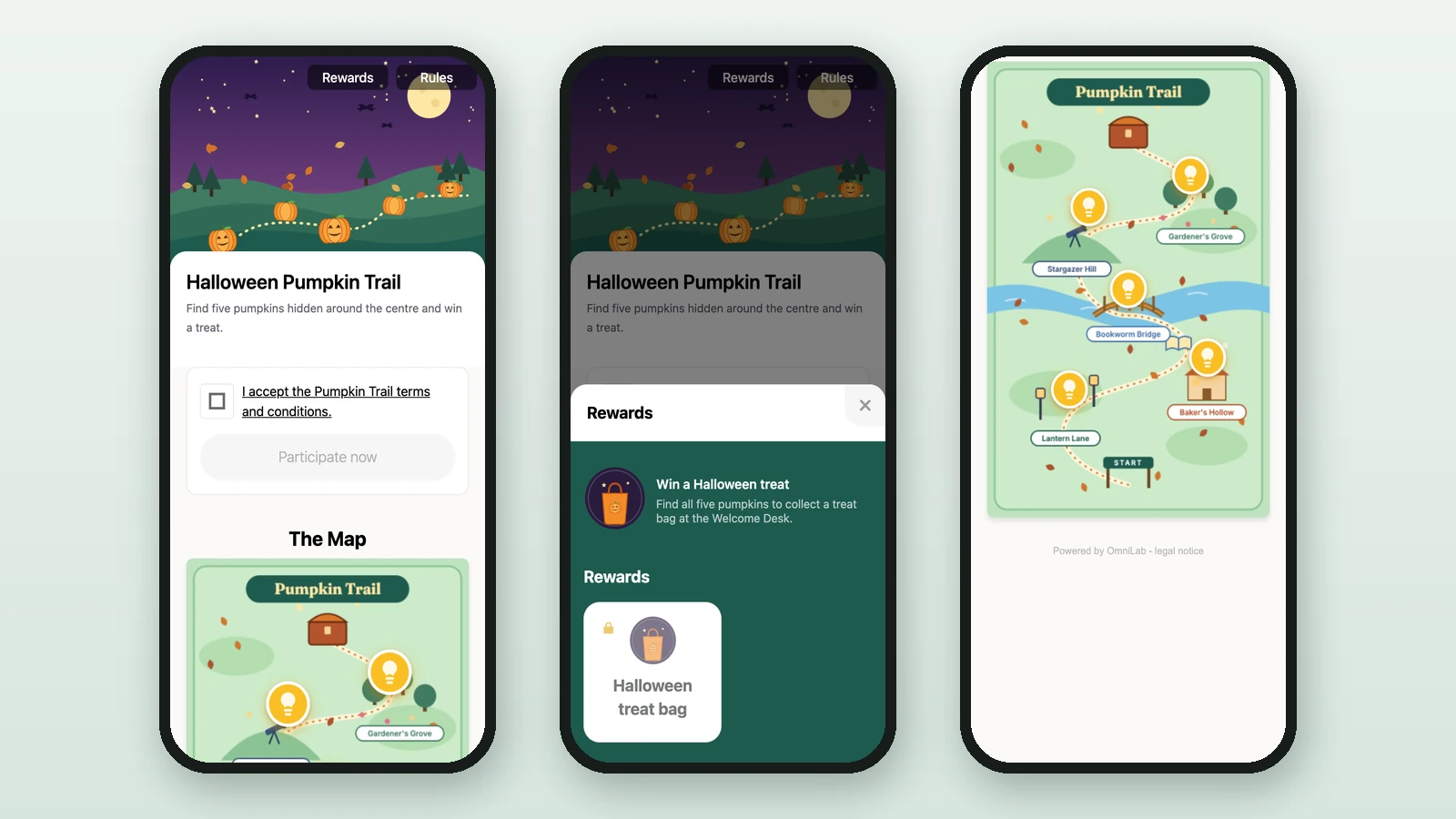
Treasure Hunts are venue-based discovery experiences inside OmniLab. Participants start from a shared hunt link or QR code, move through the space, find objects placed around the venue, and interact with each object in 3D or AR before progressing to the next step.
This makes Treasure Hunts a strong fit for activations where movement through the venue matters as much as the digital experience itself. Instead of a single moment of play, the campaign unfolds across several stops.
Treasure Hunts use shared Platform settings
Treasure Hunts can reuse the same shared Platform layers as other touchpoints, including Opt-in, Participation Form, Notifications, Rewards, and Gamification badges.
The two layers of a Treasure Hunt
Every Treasure Hunt has two parts:
| Part | What it does | Typical example |
|---|---|---|
Treasure Hunt | The parent touchpoint that defines the hunt entry experience, progression rules, completion requirements, optional map, and overall settings. | A "Summer Trail" hunt that starts at the entrance of a shopping centre. |
Treasure Hunt Object | An individual stop inside the hunt with its own title, hint, 3D or AR view, and interaction. | A branded mascot hidden near the food court or a product statue near a showcase. |
The hunt sets the overall rules. The objects are what participants actually discover and collect.
What Treasure Hunts help you do
Treasure Hunts are especially useful when you want to:
- tell a story across several locations instead of one screen
- bring a brand world to life with 3D or AR objects
- turn venue traffic into deeper engagement, opt-ins, or form completion
- make discovery feel playful through hints, questions, and progression
- unlock badges or rewards as participants complete the route
For example, a retail brand could hide four themed objects across a flagship store, or an event team could guide visitors through sponsor zones with one object per stop.
What participants experience
Depending on the setup, participants may collect objects in Any Order or follow a Sequential route. They may also need to find every object or only a specific number before the hunt is considered complete.
When to choose Treasure Hunts
Choose Treasure Hunts when your experience should pull people through a physical environment.
| App | Best when you want | Typical experience |
|---|---|---|
Treasure Hunts | Discovery across several physical stops with collection and progression. | Scan, explore, collect, and complete a route through a venue. |
Games | A single interactive play moment with a clear game mechanic. | Play a wheel, quiz, scratch card, or skill game. |
Events | Scheduled attendance, booking, or check-in. | Join a workshop, activity, or timed session. |
Transactions | Receipt-based participation or purchase validation. | Upload a receipt to qualify or win. |
If the participant journey should feel like a trail, tour, or multi-stop adventure, Treasure Hunts is usually the better fit.
Related
Your first treasure hunt
Build a simple first hunt with one object and a test-ready flow.
Create a treasure hunt
Configure the hunt container, progression rules, and completion setup.
Add a touchpoint to a campaign
See where Treasure Hunt creation starts inside the campaign builder.
Build
Go deeper into objects, assets, interactivity, and shared settings.